Forgejo Actions
GitHub Actions-compatible CI/CD automation
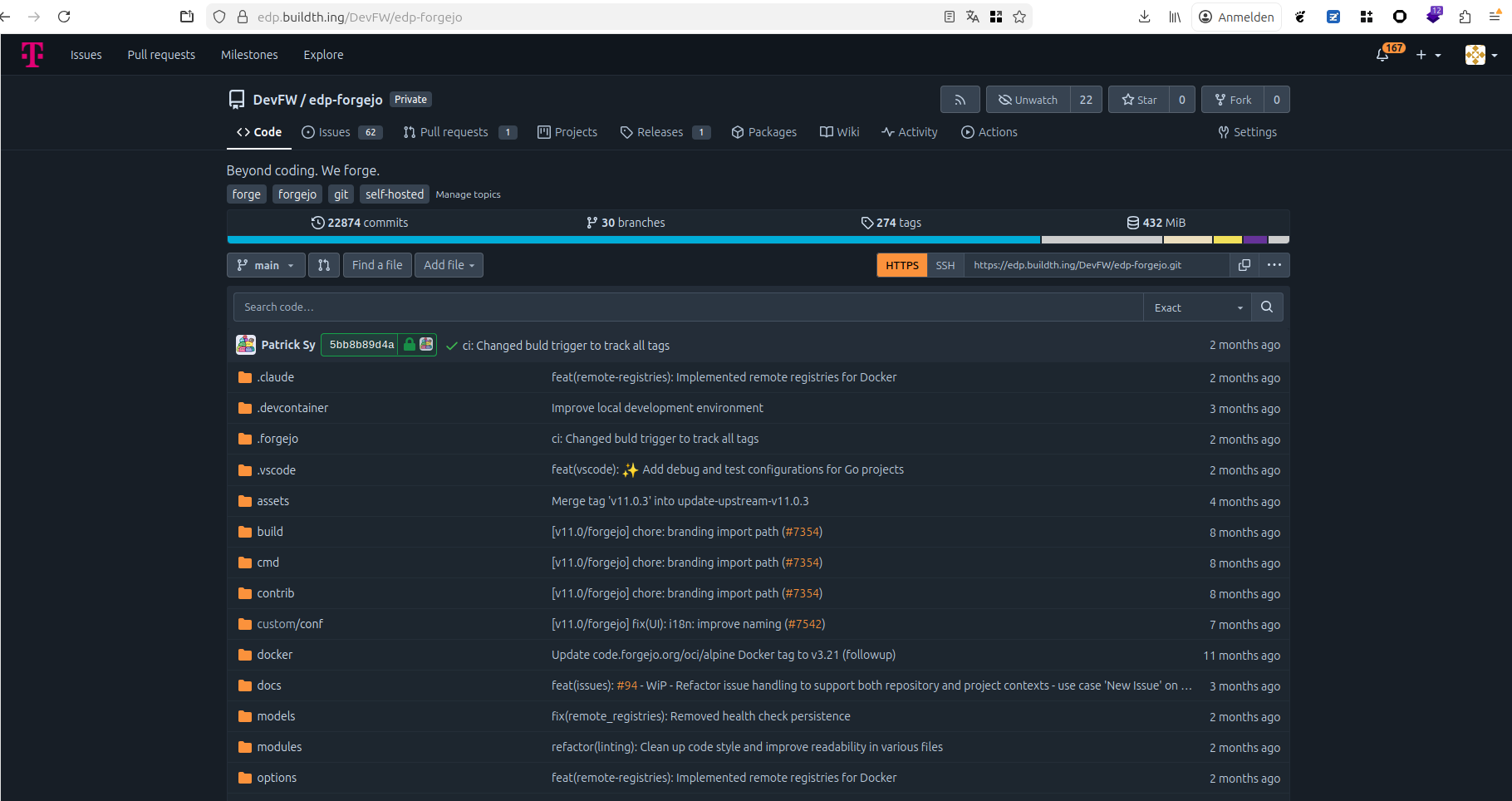
The internal service is officially designated as the Edge Developer Platform (EDP). It is hosted at edp.buildth.ing. The domain selection followed a democratic team process to establish a unique identity distinct from standard corporate naming conventions.
The platform is hosted on the Open Telekom Cloud (OTC). The infrastructure adheres to Infrastructure-as-Code (IaC) principles.
A key architectural feature is the ability of the platform to maintain itself. A Forgejo Action can trigger the deployment script, which runs Terraform and syncs ArgoCD, effectively allowing “Forgejo to create/update Forgejo.”
graph TD
    subgraph "Open Telekom Cloud (OTC)"
        subgraph "Control Plane"
            Dev[DevOps Engineer] -->|Triggers| Pipeline[Deployment Pipeline]
            Pipeline -->|Executes| TF[Terraform]
        end

        subgraph "Provisioned Infrastructure"
            TF -->|Provisions| CCE[(CCE K8s Cluster)]
            TF -->|Provisions| RDS[(RDS PostgreSQL)]
            TF -->|Provisions| Redis[(DCS Redis)]
            TF -->|Provisions| S3[(OBS S3 Bucket)]
            TF -->|Provisions| CSS[(CSS Elasticsearch)]
        end

        subgraph "Application Layer (on CCE K8s)"
            Pipeline -->|Helm Chart| Argo[ArgoCD]
            Argo -->|Deploys| ForgejoApp[Forgejo]
        end

        CCE -- Runs --> Argo
        CCE -- Runs --> ForgejoApp
        ForgejoApp -->|Connects| RDS
        ForgejoApp -->|Connects| Redis
        ForgejoApp -->|Connects| S3
        ForgejoApp -->|Connects| CSS
endThe initial environment was a manual setup on the Open Sovereign Cloud (OSC). Once the automation stack (Terraform/ArgoCD) was matured, the platform was migrated to the current OTC environment.
Beyond standard Git versioning, the platform utilizes:
The primary technical innovation was the integration of GARM to enable ephemeral, scalable runners. This required extending Forgejo’s capabilities to support GitHub-compatible runner registration and webhook events.
edp-forgejo v14 (upgraded Q1 2026, IPCEICIS-7848). The Forgejo 14 upgrade resolved outstanding version lag and enabled adoption of the latest upstream GARM integration features.We actively contributed our extensions back to the upstream Forgejo project in a list of Codeberg.org pull requests
We implemented a feature allowing Forgejo to act as a pull-through proxy for remote container registries, optimizing bandwidth and build speeds.
A security hardening initiative was completed in Q1 2026 across the EDP platform:
MFA is now enabled and enforced for all EDP platform users at edp.buildth.ing. Users are required to configure a TOTP-compatible authenticator on next login.
A review of Forgejo administration accounts and service accounts was carried out. Redundant admin and bot accounts were removed or scoped down, tightening the overall access surface of the platform.
Trivy vulnerability scanning is now automated in EDP CI/CD pipelines via a Forgejo Action. Scans cover container images, source code dependencies, and IaC configurations. Results are automatically uploaded to the Dependency-Track instance for tracking and triage.
Redis (the Distributed Cache Service powering Forgejo on OTC) was prone to filling up under active crawling load, causing 500 errors across Forgejo operations. An automated remediation was implemented:
This eliminates the need for manual intervention to restore Forgejo availability after Redis saturation events.
These KPIs measure the effectiveness of the Forgejo setup and quantify our strategic commitment to the Forgejo community.
| KPI | Description | Target / Benchmark |
|---|---|---|
| Deployment Frequency | Frequency of successful pipeline executions. | High (Daily/On-demand) |
| Artifact Cache Hit Rate | Percentage of build requests served by the local Forgejo proxy. | > 90% (Reduced external traffic) |
| Upstream Contribution | Percentage of GARM-related features contributed back to Codeberg. | 100% (No vendor lock-in) |
| PR Resolution Time | Average time for upstream community review and merge. | < 14 days (Healthy collaboration) |
GitHub Actions-compatible CI/CD automation
Organization-level project and issue management